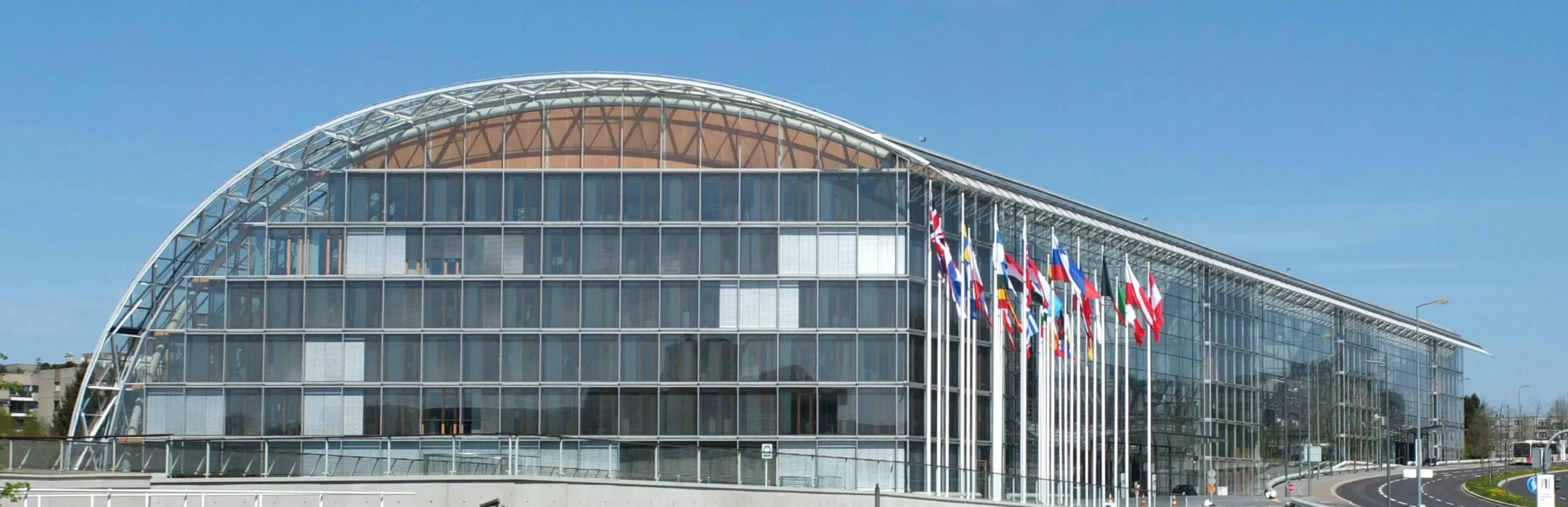
The Forum of the European Investment Bank (EIB) happened in Luxembourg in March 2026. There was a lot of talking for three days. There were many very important people – bankers, ministers and CEOs from big companies – speaking in panels and keynote speeches and there were many talks over coffee and wine. Even though it’s the public bank of Europe, the rest of society did not get a platform, there were almost no CSOs or labour unions present. No wonder the debates were disconnected from urgent social, environmental needs, let alone economic justice at the global or even the European level. The EIB Forum was all about business. Literally.
The EIB’s investment report which is traditionally launched at the Forum showed how public investment in the European economy has grown significantly in the past years, while corporate investment has stagnated. This situation was illustrated during a debate on the energy transition later that day. A speaker from the EIB admitted there is very little demand for loans to decarbonise heavy industry, which is a key priority of the Clean Industrial Deal. One way to look at this situation could be to say we should recognise the crucial role of public investment and use it strategically and make loans to companies conditional on them committing to decarbonise, as we propose in our recent report on the role of the EIB and InvestEU in the Clean Industrial Deal.
But the way forward proposed by different speakers during the Forum was that the EIB should develop more pan-European instruments to mobilise private finance by protecting their profits. These instruments are also seen as a step towards a more unified financial market in the EU, which is the ambition of the Savings and Investment Union. But this remains a highly market-led approach in a context where the corporate sector is unwilling to invest. And the instruments being proposed give no guarantee that industry will indeed be decarbonised or that public investment will ensure that other needs are met. Arcellor Mittal illustrated this problem very well during last year’s EIB Forum. Stéphane Tondo, Head of Climate Change and Governmental Affairs at Arcelor Mittal, said the company has both the money (including several sources of public money such as EIB loans) and the technology to decarbonise, but does not believe there is a good business case in Europe to actually invest in decarbonisation. ArcelorMittal doubled its profits in 2025 to more than €3 billion.
Meanwhile, companies choose the projects they want to get access to the loans with favourable conditions from the EIB. And that is exactly why many of these Very Important People came to Luxembourg. Not just to talk and drink, but to sign contracts.
Ngozi Okonjo-Iweala for instance came to Luxembourg from Geneva where she heads the World Trade Organisation (WTO) to sign an agreement with the EIB. Under this agreement, the EIB will finance projects in countries that apply the political and legal playbook of the WTO. The EIB is thus not any kind of lender. In this case, it will agree to finance projects only if the countries first and foremost implement laws that help foreign investors, not local communities; and big businesses, not small-scale cooperatives. And there was no hiding in the talking. The EIB president was pretty honest when she signed this agreement to “support reform and create new trading opportunities for EU businesses”. The WTO president added that the programme will focus on several African countries to unlock private investment in strategic sectors, including critical minerals. Europe walks the talk: it wants to open mines in Africa for European electric cars, phones, and drones.
Drones were also part of the talking. At the EIB Forum, the EIB announced a €50 million commitment to Join Capital, a capital fund investing in defence. This is part of the €175 million Defence Equity Facility (DEF), which the EIB initiated with the European Commission to mobilise private capital into Europe’s defence.
But it was not only investors talking in the EIB Forum. Dorota Zawadzka-Stępniak made it to Luxembourg to speak on energy efficiency on behalf of the Polish environment fund, whose board she presides over. She was one of the only “civil society” voices during the EIB Forum panels. Most of the talks occurred between investors and public banks. But she also came to Luxembourg to sign a contract for the Polish National Fund for Environmental Protection and Water Management (NFOŚiGW). The fund will receive €288 million to improve energy efficiency in public buildings and upgrade district heating systems in Poland. Dorota spoke in a panel on Europe’s energy sector.
She shared the floor with Eni Chief Transition Officer who mentioned some false technological solutions to climate change, such as Carbon Capture and Storage. At the end of the panel, one of the members of the civil society coalition “Green and Social EIB”, FEANTSA, mentioned the high percentage of European households living in badly insulated homes. The EIB answered. They said they can have great projects to improve the living conditions of Europeans, especially their housing and energy bills, when they work with local authorities with strong projects.
It is a shame that these projects – those aimed at improving the living conditions of Europeans – were not the ones being highlighted at the EIB Forum as success stories. Instead, one of the keynote speakers at this year’s forum was Arthur Mensch, the director of a European Artificial Intelligence (AI) company which received support from the EIB in the past. A “success story” for the EIB. A company that, according to journalists, allegedly stole books, movies, and other copyrighted material without respecting authors’ rights to train its artificial intelligence models. But this is already too much talking. Or a matter for an event with far less important people: the EIB Board Seminar with Civil Society, where there is much talking, no signing, and so far no signs of change.