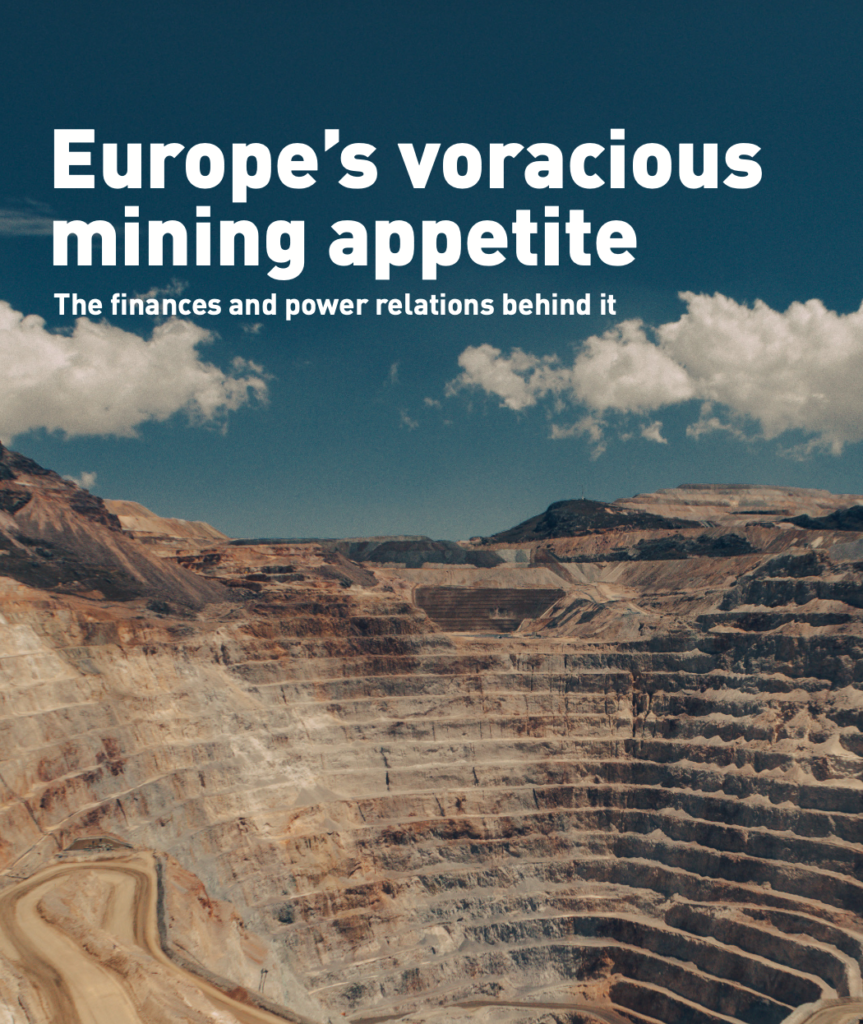

The European Union (EU) is building ‘partnerships’, mainly with countries in the Global South, to secure access to the raw materials needed for its green and digital transitions, as well as its militarisation agenda. Far from building resilient local economies, these partnerships deepen existing inequalities and power asymmetries, while allowing Europe to outsource the environmental degradation, labour exploitation, disregard for Indigenous rights, and community displacement associated with mining.
This report reviews the mining policies of the EU — Global Gateway, Critical Raw Materials Act and ResourceEU — and the public financing mechanisms behind them — European Investment Bank (EIB), European Bank for Reconstruction and Development (EBRD), and export credit agencies. It also provides analyses of mining projects and partnerships in Europe, Latin America, Africa and Asia.
Through instruments such as blended finance and public guarantees, the EU has built a financial architecture whose explicit purpose is to make mining projects profitable enough for private investors. Under this ‘de-risking’ logic, public institutions absorb the financial risks of projects, and bear the losses if they fail, while ensuring that profits flow to multinationals.
Meanwhile, raw material partnerships and projects are designed in Europe without the meaningful participation of affected communities, with limited access to information and transparency, and with project selection driven by corporate profits and geopolitics
Beyond calling for European public investments to be democratic, transparent, and to give local communities real decision-making power, this report also calls on the EU to address the levels of consumption and inequality that drive extraction in the first place.